


Ecommerce SEO Company
Traffic That Drives Revenue

Your products can’t sell if customers can’t find them. We optimize technical SEO, product pages, and categories to drive more revenue.

Ecommerce SEO Company — Turn Organic Traffic Into Orders

Your store can have thousands of products and still be invisible where it counts: the search results your buyers actually use. Most online stores aren’t losing to better competitors — they’re losing to their own thin category pages, duplicate product URLs, and a technical setup that quietly buries half the catalogue where Google never looks.

We’re ADS That Matters, an ecommerce SEO company that fixes exactly those leaks and turns organic search into a revenue channel — not a vanity ranking report. We diagnose what’s holding your store back, fix the technical foundation stores get wrong, and build the product and category pages that rank and sell. And because we run paid ads too, we use your Shopping and paid-search data to prioritise the SEO that actually drives orders.

What does an ecommerce SEO company do?

An ecommerce SEO company improves your online store’s visibility in organic search — fixing technical issues unique to stores (faceted navigation, duplicate variant URLs, crawl budget, thin category pages), optimizing product and category pages for buying-intent keywords, adding product schema, and building authority — so your catalogue ranks for the searches that turn into orders. Unlike paid ads, ecommerce SEO keeps driving revenue after you stop spending, giving it the lowest long-term cost per sale of any channel.

How long does it take, and what does it cost?

Most stores see meaningful movement in 3–6 months, compounding after that. Pricing is usually a monthly package (commonly $1,500–$8,000+/month) scaled to catalogue size and competitiveness. We won’t guarantee rankings — nobody controls Google’s algorithm — but we’ll show you exactly where the revenue leaks are first.

An ecommerce SEO company measured on organic revenue, not rankings.

987+ sites ranked • 86% average organic traffic growth • $1.2M+ organic revenue driven • 94%+ client retention.

Why most online stores underperform in search

General SEO advice doesn’t fix an ecommerce store, because stores fail in ways a blog never could. Here’s what we find in nearly every underperforming store we audit:
  • Products invisible in search. Thousands of product pages exist, but they’re not indexed, not optimized, or competing against each other — so buyers searching for exactly what you sell never see you.
  • Thin, duplicate category pages. Category pages are your biggest ranking opportunity, yet most are near-empty templates that Google sees as low-value.
  • Faceted navigation chaos. Filters and sorting (colour, size, price) generate thousands of near-duplicate URLs that waste your crawl budget and bloat your index — so Google spends its time on junk instead of your money pages.
  • Duplicate variant URLs. The same product in five colours becomes five competing pages, splitting authority and confusing search engines.
  • Out-of-stock and discontinued pages handled badly, leaking authority and frustrating buyers.
  • No buying-intent content. The store ranks (if at all) for vague terms, not the transactional “buy / best / near me” searches that actually convert.

Naming these precisely is the whole job. A free ecommerce SEO audit shows you exactly which of these are costing you orders right now.

Real ecommerce results

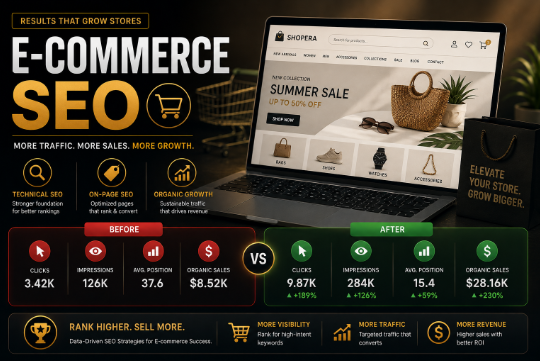
E-commerce SEO Expert | +230% Organic Sales | +189% Clicks | Better Rankings

Challenge

The client’s online store was getting low organic traffic and weak sales. Pages were ranking poorly, so visibility and revenue from search were limited.

Solution
I fixed technical SEO issues, optimized on-page content for high-intent keywords, and improved overall site structure to drive sustainable organic growth and higher sales.
Results

Clicks grew from 3.42K to 9.87K (+189%), impressions increased from 126K to 284K (+126%), average position improved from 37.6 to 15.4, and organic sales jumped from $8.52K to $28.16K (+230%).

Ecommerce technical SEO: the foundation stores get wrong

This is where an ecommerce seo service earns its fee, and where general SEO agencies fall short. The technical work specific to online stores:

  • Faceted navigation control — telling Google which filtered URLs to crawl and index, and which to ignore, so your crawl budget goes to pages that make money
  • Variant & parameter URLs — canonical tags and clean structure so five colours of one product don’t compete as five pages
  • Crawl budget & index bloat — pruning the thousands of low-value URLs stores generate, so Google focuses on your product and category pages
  • Pagination & internal linking — so deep catalogue pages are reachable and authority flows to the pages that convert
  • Out-of-stock & discontinued products — handled to preserve authority and protect the buyer experience
  • Site speed & Core Web Vitals — because a slow store loses both rankings and sales, and ecommerce sites are usually heavy
  • Product schema & rich results — structured data for price, availability, and reviews, so your listings stand out with rich snippets and stay eligible for AI and shopping surfaces

Fix this foundation and everything above it — content, rankings, authority — finally gets traction.

Product and category pages that rank and sell

In ecommerce, your category and product pages are your money pages — so they have to do double duty: rank in search and convert the visitor.

  • Category pages as authority hubs — unique, genuinely useful content that earns rankings for high-value category terms instead of sitting as thin templates
  • Product-page optimization — titles, descriptions, and structured data written for both search engines and buyers, not copied from the manufacturer
  • Unique product descriptions — because duplicate manufacturer copy is invisible to Google and forgettable to shoppers
  • Internal linking that guides authority (and buyers) toward your best-converting pages

The ecommerce SEO terms that matter

Term What It Means
Organic Revenue Sales driven by unpaid search — the metric that actually matters.
Transactional Keywords Buying-intent searches ("buy," "best," "near me") that convert.
Faceted Navigation Filter/sort options that can generate crawl-wasting duplicate URLs.
Crawl Budget How many pages Google will crawl — precious on a big catalogue.
Index Bloat Too many low-value URLs indexed, diluting your store's strength.
Product Schema Structured data for price, availability, and reviews (rich results).
Canonical Tag Tells Google the "main" version of duplicate/variant pages.
AOV / RPV Average order value / revenue per visit — ecommerce health metrics.
Core Web Vitals Google's page-speed and stability metrics — heavier on stores.

Keyword and content strategy built on buying intent

Traffic that never buys is a cost, not a win. We build your ecommerce SEO around the searches closest to a purchase:
  • Transactional keywords first — the bottom-of-funnel terms buyers use when they’re ready to order, mapped to the right product or category page
  • The right content for the right stage — product pages to sell, category pages to rank for broad terms, and buyer’s guides and comparisons to capture research-stage demand and feed it into your funnel
  • Content gap analysis — finding the buying-intent searches your competitors rank for and you don’t

Authority that lifts your whole catalogue

Rankings for competitive product and category terms need authority. We build it the sustainable way — product-launch link building, digital PR that earns real coverage, and the domain authority that raises every page’s ceiling. White-hat only; no schemes that risk a penalty on a store you depend on.

Ecommerce SEO for your platform

Every ecommerce platform has its own SEO quirks, and knowing them is half the battle:

  • Shopify SEO — fixing variant-URL duplication, thin collection pages, and app bloat that quietly slows the store and caps rankings
  • Magento SEO — taming layered navigation, managing large catalogues, and the technical complexity Magento invites
  • BigCommerce SEO — optimizing the platform’s structure and built-in features for organic visibility
  • WooCommerce SEO — WordPress-based stores need plugin hygiene, speed work, and clean product/category structure
As an enterprise ecommerce SEO partner, we also handle large, complex catalogues — tens of thousands of SKUs, multiple categories, and the crawl and architecture challenges that come with scale.

Ecommerce SEO and paid, run as one system

Here’s what a pure-SEO agency can’t offer a store owner: we run paid media too, and for ecommerce that’s a genuine edge.

  • Shopping-feed and paid-search data sharpen your SEO. We can see exactly which products and search terms convert in your Google Shopping and paid campaigns — so we prioritise SEO for the pages that actually drive orders, not guesses.
  • SEO lowers your paid costs over time. As your product and category pages rank organically, you can pull back paid spend on those terms and redeploy it — your blended cost per order drops.
  • One team owns the whole result — organic and paid working together, not two vendors arguing over who earned the sale.

Ecommerce SEO in 2026: getting your products found by AI

Shoppers increasingly research — and get recommendations — inside Google AI Overviews and AI assistants like ChatGPT and Perplexity, often before they reach a store. That changes ecommerce SEO:

  • Product visibility in AI answers now depends on clean structured data, strong reviews, and authoritative content AI can trust and cite (Generative Engine Optimization).
  • Product schema and Merchant Center feeds matter more than ever — they feed both organic free listings and AI shopping surfaces.
  • Zero-click means intent is everything — the shoppers who still click are higher-intent, so we optimise for the searches that convert.
We build for how shoppers actually search now

How we measure and report

No black boxes. We track GA4 ecommerce reporting, Google Search Console, and rank data — organic revenue, product and category rankings, organic conversion rate, and share of voice — and report in plain English on what’s driving orders, not just traffic. You get always-on dashboard access and a real strategist who explains what’s next.

Ecommerce SEO packages and pricing

Ecommerce SEO is an ongoing, compounding investment, so it’s almost always a monthly package — but how much work it takes swings hugely with your catalogue. A small store building organic revenue and a 10,000-SKU catalogue in a competitive category are completely different jobs, which is why we scale the package to your store rather than post one number that fits neither.

We work in tiers — an entry level for small-to-mid catalogues building organic revenue, a higher level for larger stores in competitive categories, and fully custom for large, complex catalogues — plus a one-time audit that hands you a deep ecommerce SEO diagnostic and roadmap you can act on. We’ll recommend the right fit for your store.

Why we don’t guarantee rankings: nobody controls Google’s algorithm, so a guaranteed #1 is either meaningless or built on risky tactics that get stores penalized. What we guarantee is disciplined white-hat work and transparent reporting — with no long-term contract.

To get your number: book a free call. We’ll review your store and catalogue, then send a clear, custom quote — no obligation.

Agency, in-house, or DIY?

ADS That Matters In-House Hire DIY
Cost Package or retainer — full team Salary + benefits + tools "Free" until technical issues cost you sales
Ecommerce Technical Depth Faceted nav, crawl budget, schema daily Depends on the hire Usually the hardest part to get right
Platform Know-How Shopify / Magento / BigCommerce / Woo Often one platform Whatever you can learn
Integrated with Paid Yes — Shopping data informs SEO No No
Best For Most stores from SMB to enterprise Very large, always-on catalogues Tiny stores testing
The takeaway: ChatGPT ads reach people later in the thinking and earlier in the deciding — the exact point where a recommendation carries the most weight. That’s why it’s worth understanding now, even while it’s young.

Why stores choose ADS That Matters as their ecommerce SEO company

  • You own everything — your store, content, and data stay yours, always.
  • Technical ecommerce depth — the faceted-nav, crawl-budget, and schema work that general agencies skip.
  • Integrated with paid — Shopping-feed data prioritises the SEO that drives orders; nobody who only does SEO can offer this.
  • White-hat only — sustainable growth, never shortcuts that risk your store.
  • Transparent reporting — organic revenue and rankings, always-on access.
  • No long-term contracts — earned month to month.

Free ecommerce SEO audit — no obligation. We’ll show you exactly which technical issues, thin pages, and missed buying-intent keywords are costing you orders, and hand you a clear roadmap.

Ecommerce SEO questions

How much does a performance marketing agency cost?
The cost of hiring a performance marketing agency depends on your monthly advertising budget, campaign complexity, and the services included. Most businesses invest in a combination of management fees and advertising spend to achieve measurable, scalable growth.
Yes. Depending on your business goals and advertising budget, we offer fixed monthly retainers, percentage-of-ad-spend pricing, performance-based models, and hybrid pricing structures. We’ll recommend the model that best aligns with your growth objectives.

Yes. We generally recommend a minimum monthly advertising budget of $3,000–$5,000. This provides enough conversion data for paid platforms to optimize campaigns effectively and produce statistically meaningful results.

Some projects require an initial setup fee, particularly when building new advertising accounts, implementing GA4, server-side tracking, Google Tag Manager, Meta Conversions API, or creating landing pages. Existing accounts usually require a detailed audit before recommendations are made.

We offer flexible engagement models based on your business needs. While long-term partnerships typically achieve the strongest results, our focus is on delivering measurable performance rather than locking clients into lengthy contracts.

You do. Your Google Ads account, Meta Ads account, Google Analytics, tracking setup, conversion data, audiences, and creative assets remain your property. We believe every client should retain full ownership of their marketing assets.

Most campaigns begin generating meaningful optimization data within the first 30 days. Significant improvements in ROAS, CAC, and revenue typically occur within 60 to 90 days, depending on your industry, competition, advertising budget, and historical account performance.

A good Return on Ad Spend (ROAS) depends on your profit margins and business model. While many businesses target 3:1 ROAS, ecommerce brands with lower margins may require higher returns, whereas businesses with high customer lifetime value (LTV) can remain profitable with a lower ROAS.

An agency provides immediate access to experienced specialists across Google Ads, Meta Ads, analytics, creative strategy, SEO, CRO, and attribution- without the cost of hiring and managing multiple full-time employees. Many growing businesses find agencies more cost-effective until they reach enterprise scale.

We focus on business metrics that directly impact profitability, including:

  • Return on Ad Spend (ROAS)
  • Cost Per Acquisition (CPA)
  • Cost Per Lead (CPL)
  • Marketing Efficiency Ratio (MER)
  • Customer Lifetime Value (LTV)
  • LTV:CAC Ratio
  • Conversion Rate
  • Revenue
  • Qualified Leads

Digital marketing includes every online marketing activity, including SEO, content marketing, social media, email marketing, and paid advertising. Performance marketing focuses specifically on measurable results where campaigns are optimized around outcomes like revenue, leads, ROAS, and customer acquisition rather than awareness or impressions.

We manage campaigns across Google Ads, Performance Max, Meta Ads, Facebook Ads, Instagram Ads, TikTok Ads, YouTube Ads, LinkedIn Ads, Google Shopping, Display Advertising, as well as SEO, Email Marketing, and Conversion Rate Optimization (CRO).

Every campaign is tracked using Google Analytics 4 (GA4), Google Tag Manager (GTM), Meta Conversions API, Server-Side Tracking, Consent Mode v2, and Looker Studio dashboards. This allows us to accurately measure conversions, attribution, revenue, ROAS, CAC, and overall marketing performance.

Clients receive access to real-time reporting dashboards, regular campaign updates, monthly performance reports, and bi-weekly Zoom meetings. Every report focuses on measurable business outcomes, helping you understand exactly how your advertising investment is performing.

What clients say

Ethan Ryder Marketing Director, CMO, Medical Company

Ads That Matters' work reduced the client's CPL by 62% and increased lead quality by 67%. The team was responsive, delivered work on time, and provided weekly updates and monthly reports. Ads That Matters was data-driven, focused on the client's CPL metric, and understood the client's business.

Michael Anderson Founder, Elevate Growth Media

After the iOS 14 update, our Facebook campaigns stopped producing quality leads. The team implemented CRM integration, Offline Conversions, and first-party data strategies, reducing our Cost Per Lead from $42 to $31 while significantly improving lead quality.”

Jason Mitchell CEO, Peak Commerce Group

We had worked with multiple agencies before ADS That Matters, but none could scale our campaigns profitably. In just 60 days, they increased sales by 45% while maintaining strong ROAS. Their communication and reporting are second to none.

Sarah Thompson Growth Manager, Northstar Digital Commerce

The team doesn’t just manage ads—they understand the numbers behind business growth. Every recommendation is backed by data, and their reporting gives us complete visibility into ROAS, CAC, and revenue. They truly feel like an extension of our marketing team.


Ready to turn organic search into orders?

Book a free ecommerce SEO audit. We’ll show you exactly which technical leaks, thin pages, and missed buying-intent keywords are costing you sales — and hand you a clear roadmap to fix them. No obligation, no jargon.