Views look fine but revenue doesn’t move? ADS That Matters runs YouTube Ads as a performance channel — built to sell, not just play.
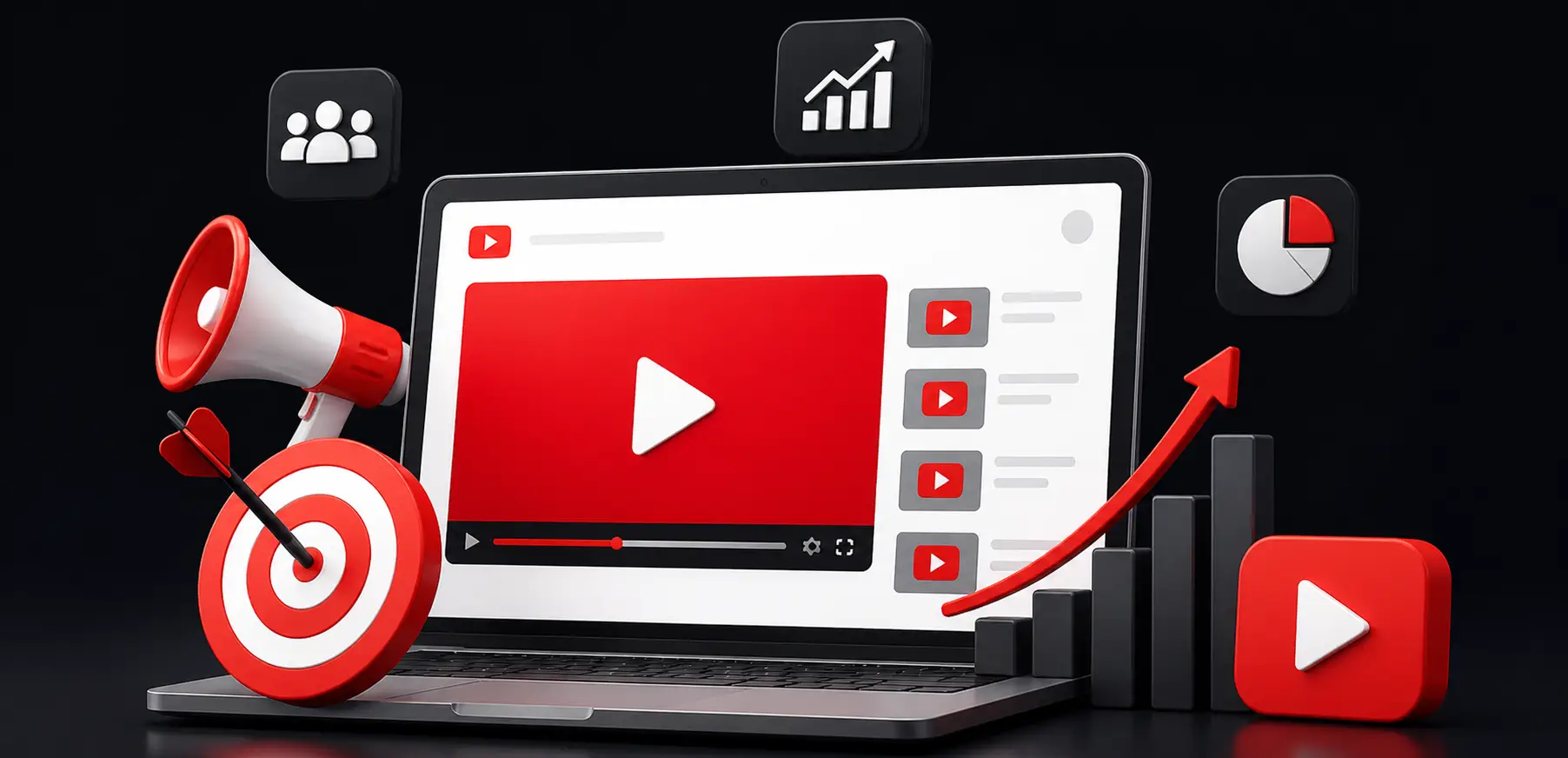
We’re ADS That Matters, a YouTube ads agency that runs your video advertising for you — from choosing the right campaign type and directing the creative, to managing bids and proving what actually made money. We treat video as a performance channel, not a branding exercise, so your spend turns into sales instead of view counts.
A YouTube ads agency plans, builds, and manages your video advertising inside Google Ads — choosing campaign types and formats, building audience targeting, directing or producing the creative, setting up conversion tracking, and optimizing against cost per acquisition rather than views. Because YouTube ads run through the Google Ads platform, the same account controls bidding, audiences, and measurement across Search, Display, and video.
YouTube advertising has three cost layers, and most agencies only mention one: media (roughly $0.10–$0.30 CPV or $4–$15 CPM, depending on targeting and competition), video production (from repurposing footage you own to a full shoot), and management (commonly $1,000–$5,000+/month or 10–20% of spend). Full breakdown below.
Before we run a single campaign, we make sure YouTube is actually the right channel for you — because a good YouTube advertising agency should tell you the truth, not just take the budget. Here’s the honest version, so you know exactly where you stand.
These channels aren’t rivals; they do different jobs in the same funnel. The mistake is treating them as interchangeable.
| Channel | What It's Actually Good At | Where It Struggles |
|---|---|---|
| Google Search | Capturing people who already want what you sell | Limited by search volume; can't create new demand |
| YouTube | Creating demand and explaining value visually at scale; cheap reach; strong retargeting closer | Longer payback; needs video assets; harder to attribute |
| Meta (Facebook & Instagram) | Fast creative testing, social proof, precise interest and lookalike audiences | Creative fatigues quickly; signal loss complicates tracking |
Most accounts that scale end up running all three, with search capturing demand, Meta → testing creative cheaply, and YouTube doing the explaining and the demand generation. We’ll tell you which order makes sense for your business — see our Google Ads services → and the wider PPC management → picture.
This is the single most common reason businesses never run YouTube ads — and the reason most youtube advertising agencies quietly avoid the topic. You don’t need a film crew or a five-figure production budget to start. You need something watchable that makes a clear point in the first five seconds.
Fewer than agencies imply, more than one. A first meaningful test usually needs three to five variants — different hooks, lengths, and aspect ratios (16:9 for in-stream, 9:16 for Shorts) — because on YouTube the hook is the variable that moves cost per acquisition most.
We can direct and produce creative, edit assets you already have, or work alongside your in-house team and stick to strategy, media, and measurement. Whichever route fits, we plan for a steady flow of new creative rather than one hero video expected to last a year.
Google published a creative framework built on analysis of thousands of video ads, known as ABCD — Attention, Branding, Connection, Direction. We build it because it maps almost exactly to what we see in accounts.
| Principle | What It Means in Practice |
|---|---|
| Attention | Earn the first five seconds. Open on motion, a face, a problem, or the product in use — never a logo animation or a slow establishing shot. |
| Branding | Show the brand early and naturally, woven into the story rather than saved for a card at the end most viewers never reach. |
| Connection | Make someone feel something or understand something — the product solving a real problem beats a features list. |
| Direction | Ask clearly for one action. A specific spoken and on-screen call to action outperforms a passive end card. |
YouTube ads are bought and managed inside Google Ads, in an auction where you generally pay per view (CPV) or per thousand impressions (CPM) rather than per click. Your ads can appear before or during videos, in search and browse feeds, between YouTube Shorts, on the masthead, and increasingly on Connected TV — the living-room screen that now accounts for a large share of watch time.
That’s also why YouTube gets misjudged. Search proves itself in days on last-click reporting; video often does its work earlier in the journey, where a plain last-click report can’t see it. Good youtube ads management accounts for that instead of pretending it away — which is what the measurement section below is about.
| Term | What It Actually Means |
|---|---|
| CPV | Cost per view — what you pay when someone watches or engages. |
| CPM | Cost per 1,000 impressions — how expensive your reach is. |
| View Rate (VTR) | Share of impressions that became views — a fast read on whether the hook works. |
| Watch Time / Average View Duration | How long people actually stay — where creative problems show up first. |
| Video Quartiles | How many viewers reach 25%, 50%, 75%, and 100% of your ad. |
| Earned Views | Extra views, subscribes, or shares your ad generates beyond paid delivery. |
| View-Through Conversions | Conversions from people who watched but didn't click — the metric most reports miss. |
| Brand Lift | A Google-run study measuring recall, awareness, and consideration. |
| CPA / ROAS | Cost per acquisition and return on ad spend — what we're actually judged on. |
| Format | Best For | What Matters |
|---|---|---|
| Skippable In-Stream | Conversions and efficient reach | You pay when they stay — the first five seconds do all the work. |
| Non-Skippable In-Stream (15s) | Guaranteed message delivery | Higher CPM; only worth it when the message must land whole. |
| Bumper Ads (6s) | Recall and frequency | One idea, one visual, one line — brilliant for reinforcing a bigger campaign. |
| In-Feed Video Ads | Intent-led discovery | Appear in search and suggested feeds; the thumbnail and title do the selling. |
| YouTube Shorts Ads | Cheap reach and younger audiences | Vertical 9:16, fast hook, native feel — the fastest-growing surface on the platform. |
| Masthead | Mass-reach launches | Reservation-only homepage placement, priced for large brand campaigns. |
| Campaign Type | Use It For | Optimizes Toward |
|---|---|---|
| Video Views | Efficient views and consideration | Views and engagement at the lowest cost |
| Video Reach | Broad awareness, launches | Unique reach, usually on target CPM |
| Demand Gen | Conversions and lead generation from video | Actions — clicks, leads, sales across YouTube, Shorts, Discover and Gmail |
| Performance Max | Cross-channel goal-based buying | Conversions or conversion value, using YouTube as one of several surfaces |
| App Campaigns | Installs and in-app actions | App events across Google's surfaces |
A note on terminology, because it tells you a lot about an agency: TrueView is retired branding, and Video Action Campaigns were folded into Demand Gen. Pages still selling “TrueView campaigns” are describing a Google Ads interface that no longer exists — which usually means the playbook underneath hasn’t been updated either.
Targeting is where YouTube stops being television and starts being performance media.
| If Your Goal Is… | Format | Campaign Type |
|---|---|---|
| Sales or leads from video | Skippable in-stream + Shorts | Demand Gen |
| Cheap reach for a launch | Bumper + non-skippable | Video Reach |
| Consideration on a complex product | Skippable in-stream (longer) | Video Views |
| Retargeting warm visitors | Skippable in-stream + in-feed | Demand Gen with remarketing |
| eCommerce catalogue scale | Video within a wider setup | Performance Max |
| Being found on YouTube search | In-feed video ads | Video Views |
Account, tracking, and existing creative reviewed — including whether YouTube is your best next move at all
Decide what we repurpose, what we produce, and which hooks we're testing
Campaign types, audiences, exclusions, bidding, and conversion tracking configured properly
Ads live; view rate, quartiles, and early conversions watched daily
Budget follows the winning hooks and audiences; weak variants retired before fatigue sets in
This is the question that decides whether video advertising survives its first quarter in most companies — and almost nobody answers it before taking your money.
The problem is structural. A last-click report credits the final touch before purchase, which on video is often a branded search or a direct visit days later. So YouTube does the persuading and Search gets the credit, and a perfectly healthy campaign looks like a failure in a spreadsheet.
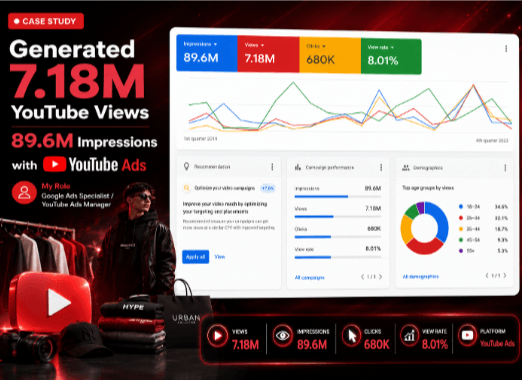
The client needed to expand brand reach on YouTube, but existing video campaigns were not generating enough engagement or efficiently reaching the right audience.
Generated 89.6M impressions and achieved strong video engagement, including a high view-through rate and click-through rate, helping the clothing brand significantly expand its reach and outperform industry benchmarks.
Most agencies quote one number and let you discover the other two later. YouTube advertising has three cost layers, and you deserve to see all three before you commit — so here’s the honest breakdown of what you’re actually paying for.
| ADS That Matters | In-House Hire | DIY | |
|---|---|---|---|
| Cost | Retainer or % of spend — full team | Salary + benefits + tools | "Free" until you count wasted media |
| Creative Capability | Strategy, direction, and production access | Usually one skill set | Whatever you can make |
| Campaign-Type Expertise | Demand Gen, Video Views/Reach, PMax daily | Depends on the hire | Commonly the wrong type entirely |
| Measurement Setup | View-through, GA4, Brand Lift, incrementality | Varies | Usually last-click only |
| Best For | Most SMBs to enterprise | Large, always-on video budgets | Very small tests |

Free YouTube ads audit — no obligation. We’ll review your account, creative, and tracking, and tell you honestly whether video is your best next investment.
Yes. We generally recommend a minimum monthly advertising budget of $3,000–$5,000. This provides enough conversion data for paid platforms to optimize campaigns effectively and produce statistically meaningful results.
We offer flexible engagement models based on your business needs. While long-term partnerships typically achieve the strongest results, our focus is on delivering measurable performance rather than locking clients into lengthy contracts.
You do. Your Google Ads account, Meta Ads account, Google Analytics, tracking setup, conversion data, audiences, and creative assets remain your property. We believe every client should retain full ownership of their marketing assets.
Most campaigns begin generating meaningful optimization data within the first 30 days. Significant improvements in ROAS, CAC, and revenue typically occur within 60 to 90 days, depending on your industry, competition, advertising budget, and historical account performance.
A good Return on Ad Spend (ROAS) depends on your profit margins and business model. While many businesses target 3:1 ROAS, ecommerce brands with lower margins may require higher returns, whereas businesses with high customer lifetime value (LTV) can remain profitable with a lower ROAS.
An agency provides immediate access to experienced specialists across Google Ads, Meta Ads, analytics, creative strategy, SEO, CRO, and attribution- without the cost of hiring and managing multiple full-time employees. Many growing businesses find agencies more cost-effective until they reach enterprise scale.
We focus on business metrics that directly impact profitability, including:
Digital marketing includes every online marketing activity, including SEO, content marketing, social media, email marketing, and paid advertising. Performance marketing focuses specifically on measurable results where campaigns are optimized around outcomes like revenue, leads, ROAS, and customer acquisition rather than awareness or impressions.
We manage campaigns across Google Ads, Performance Max, Meta Ads, Facebook Ads, Instagram Ads, TikTok Ads, YouTube Ads, LinkedIn Ads, Google Shopping, Display Advertising, as well as SEO, Email Marketing, and Conversion Rate Optimization (CRO).
Every campaign is tracked using Google Analytics 4 (GA4), Google Tag Manager (GTM), Meta Conversions API, Server-Side Tracking, Consent Mode v2, and Looker Studio dashboards. This allows us to accurately measure conversions, attribution, revenue, ROAS, CAC, and overall marketing performance.
Clients receive access to real-time reporting dashboards, regular campaign updates, monthly performance reports, and bi-weekly Zoom meetings. Every report focuses on measurable business outcomes, helping you understand exactly how your advertising investment is performing.

Ads That Matters' work reduced the client's CPL by 62% and increased lead quality by 67%. The team was responsive, delivered work on time, and provided weekly updates and monthly reports. Ads That Matters was data-driven, focused on the client's CPL metric, and understood the client's business.
After the iOS 14 update, our Facebook campaigns stopped producing quality leads. The team implemented CRM integration, Offline Conversions, and first-party data strategies, reducing our Cost Per Lead from $42 to $31 while significantly improving lead quality.”
We had worked with multiple agencies before ADS That Matters, but none could scale our campaigns profitably. In just 60 days, they increased sales by 45% while maintaining strong ROAS. Their communication and reporting are second to none.
The team doesn’t just manage ads—they understand the numbers behind business growth. Every recommendation is backed by data, and their reporting gives us complete visibility into ROAS, CAC, and revenue. They truly feel like an extension of our marketing team.
Book a free YouTube ads audit. We’ll review your account, creative, and tracking, and give you an honest answer — including “not yet” if that’s the truth.