







We’re ADS That Matters, a display advertising agency that runs display the way it’s supposed to work reaching the right people across the Google Display Network and programmatic exchanges, keeping your ads visible and brand-safe, and measuring the conversions display actually causes instead of the ones it gets blamed for missing.
Display advertising services cover the planning, creative, targeting, buying, and optimization of visual ads — image, native, and video banners — shown across websites, apps, and Connected TV through the Google Display Network and programmatic platforms. Unlike search ads that capture existing demand, display reaches people while they browse, building awareness and retargeting past visitors until they convert.
Display has two cost layers: media (typically $2–$10 CPM, higher for niche or Connected TV inventory) and management (commonly $750–$4,000+/month or 10–20% of ad spend). Because display is a browse-intent channel, most of its value shows up in view-through conversions rather than immediate clicks — which is exactly why it gets underrated.
Display advertising is paid promotion using visual ads — image banners, responsive display ads, native, and video — served across a vast network of websites, mobile apps, YouTube, Gmail, and Connected TV. Where a Google Search ad captures someone who is already looking for you (search intent), the display reaches people while they browse, read, and watch (browse intent). That single difference explains almost everything about how displays should be run and judged.
| Term | What It Actually Means |
|---|---|
| CPM | Cost per 1,000 impressions — the main way display media is priced. |
| vCPM | Viewable CPM — cost per 1,000 viewable impressions, not just served ones. |
| Viewability | The share of your ads that actually appeared on-screen long enough to be seen. |
| CTR | Click-through rate — naturally low on display, and not the metric that matters most. |
| View-Through Conversion | A conversion by someone who saw your ad, didn't click, and converted later. |
| Frequency | How many times one person sees your ad — the lever for fatigue and waste. |
| Remarketing | Showing ads to people who already visited your site or used your app. |
| GDN | Google Display Network — Google's inventory of 2M+ sites and apps. |
| DSP | Demand-side platform — the software used to buy programmatic inventory. |
| RTB | Real-time bidding — the live auction that fills most programmatic impressions. |
| IVT / MFA | Invalid traffic (bots) and made-for-advertising junk sites — where budget leaks. |
“Display” isn’t one place — it’s a stack of networks and inventory sources, each with its own strengths. As a google display ads agency and a programmatic buyer, we choose the mix your goal actually needs rather than defaulting to whatever’s easiest.
| Format | Best For | Note |
|---|---|---|
| Responsive Display Ads | Maximum reach, minimum setup | You supply assets; Google assembles and resizes them to fit almost any placement. |
| Uploaded / Static Banners | Brand control | Fixed designs in set sizes — more control, less reach than responsive. |
| HTML5 Ads | Animation & interactivity | Motion and lightweight interaction that outperform static in many placements. |
| Native Ads | Blending into content | Match the host page's style; strong for consideration. |
| Gmail Ads | Inbox reach | Expandable ads inside the Promotions tab. |
| Video Display Ads | Attention & CTV | Short video across display and Connected TV inventory. |
The sizes that carry most of the volume: 300×250 (medium rectangle), 728×90 (leaderboard), 160×600 (wide skyscraper), 300×600 (half-page), and 320×50 (mobile banner). We design or adapt across all of them so you’re never locked out of inventory because an ad size is missing.
The display doesn’t fail because the format is weak. It fails for three specific, fixable reasons — and almost no agency will name them, because two of the three are uncomfortable to admit.
Cheap impressions are easy. The right impressions are the job. Here’s how we control who sees your ads:
On display, your ad is competing with the content someone actually came to see. That raises the bar for creativity, and it’s where most campaigns quietly lose.
Both buy display inventory. They’re not the same, and you shouldn’t pay for the more complex one before you need it.
| Google Display Network (GDN) | Programmatic (via DSP) | |
|---|---|---|
| Access | Inside Google Ads — fast to launch | Requires a demand-side platform |
| Reach | 2M+ sites and apps + Gmail + YouTube | Broader — open exchanges, native, CTV, PMP deals |
| Control | Good targeting and exclusions | Finer audience, inventory, and bidding control |
| Best For | Most SMBs and a strong starting point | Larger budgets needing scale, premium inventory, or CTV |
Account, tracking, current placements, and wasted/fraudulent spend reviewed
Decide GDN vs programmatic, audiences, and exclusion lists before a dollar goes out
Build or adapt responsive and custom banners across every key size
Campaigns live with viewability targets and brand-safety controls in place
Prune MFA/low-viewability placements weekly; tune bids, frequency, and creative
Expand winning audiences and inventory; graduate to programmatic where it earns it
| If Your Goal Is… | Targeting | Format |
|---|---|---|
| Brand awareness at scale | Affinity + contextual | Responsive + video display |
| Bringing back site visitors | Remarketing | Responsive + custom banners |
| eCommerce product sales | Dynamic remarketing + Customer Match | Dynamic / HTML5 |
| Reaching in-market buyers | In-market + custom segments | Responsive + native |
| Premium, brand-safe reach | PMP deals (programmatic) | Custom + CTV |
This is where display lives or dies inside a company, and it’s the question all four competitors avoid.
The problem is structural. Display, like YouTube, works earlier in the journey than search — so a last-click report hands the credit to the final Google search or direct visit and makes a perfectly healthy display campaign look like a failure. Here’s what we set up and report instead:
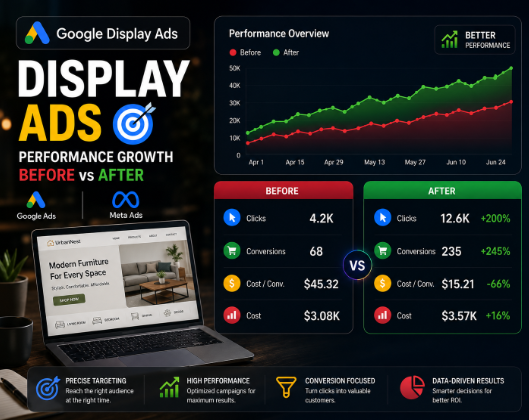
The campaigns were generating clicks but conversions remained low. Budget was being spent on underperforming placements and audiences without consistent results.
I restructured the Display campaigns, refined audience and placement targeting, shifted budget to high-performing segments, tested new creative variations, and improved conversion tracking.
Clicks increased from 4.2K to 12.6K (+200%) and conversions from 68 to 235 (+245%), while cost per conversion dropped from $45.32 to $15.21 (–66%)
Display has two cost layers, and most agencies only mention one — so here’s the full picture before you commit. Your management fee always stays separate from the media budget that goes to Google or the exchanges.
Layer 1 — Media (what the exchanges get)
This is your ad budget, usually billed per thousand impressions (CPM) — and where you land depends on placement: broad Display Network sits cheapest, while niche, native, and Connected TV placements cost more. What matters more than the raw CPM is viewability, so we optimize toward viewable impressions — you’re paying for ads that can actually be seen, not just served into the void.
Layer 2 — Management (what we charge)
Our fee for building, running, and optimizing it all — flexible across a flat monthly retainer, a percentage of ad spend, or one-time audit and advisory work, always separate from your media budget. Creative design (your banners) may be included or quoted separately, depending on how many sizes and variants you need.
Why there’s no management number on this page
An awareness campaign and a dynamic-remarketing eCommerce build need completely different amounts of hands-on work — so a single figure would misprice one of them. We scope your price after seeing your account and goals, with no long-term contract.
| ADS That Matters | In-House Hire | DIY | |
|---|---|---|---|
| Cost | Retainer or % of spend — full team | Salary + benefits + tools | "Free" until you count wasted impressions |
| Inventory Expertise | GDN + programmatic + CTV daily | Usually GDN only | Whatever you can figure out |
| Fraud & Viewability Control | Active exclusions + monitoring | Depends on the hire | Rarely managed at all |
| Creative Across Sizes | Full set, tested | Limited | Often one or two sizes |
| Best For | Most SMBs to enterprise | Large, always-on display budgets | Very small tests |
Free display audit — no obligation. We’ll show you exactly where your current display budget is leaking — unseen impressions, fraudulent placements, or the wrong measurement — before you spend a dollar with us.
Our streamlined process ensures effective, data-driven strategies tailored to your goals for achieving impactful digital marketing results.
We get into your Meta Business Manager (or set it up properly), review historical data, and map where the budget is leaking.
The funnel was rebuilt; the Meta Pixel, Conversions API, and event setup were checked and fixed-something usually needs fixing.
Creative goes live; we watch cost per result, frequency, and early conversions daily.
A plain-English report: what changed, what the numbers say, what's next. Most accounts need 45–90 days before we're scaling off statistically solid data-we won't pretend otherwise.
Ads That Matters' work reduced the client's CPL by 62% and increased lead quality by 67%. The team was responsive, delivered work on time, and provided weekly updates and monthly reports. Ads That Matters was data-driven, focused on the client's CPL metric, and understood the client's business.
After the iOS 14 update, our Facebook campaigns stopped producing quality leads. The team implemented CRM integration, Offline Conversions, and first-party data strategies, reducing our Cost Per Lead from $42 to $31 while significantly improving lead quality.”
We had worked with multiple agencies before ADS That Matters, but none could scale our campaigns profitably. In just 60 days, they increased sales by 45% while maintaining strong ROAS. Their communication and reporting are second to none.
The team doesn’t just manage ads—they understand the numbers behind business growth. Every recommendation is backed by data, and their reporting gives us complete visibility into ROAS, CAC, and revenue. They truly feel like an extension of our marketing team.

Yes. We generally recommend a minimum monthly advertising budget of $3,000–$5,000. This provides enough conversion data for paid platforms to optimize campaigns effectively and produce statistically meaningful results.
We offer flexible engagement models based on your business needs. While long-term partnerships typically achieve the strongest results, our focus is on delivering measurable performance rather than locking clients into lengthy contracts.
You do. Your Google Ads account, Meta Ads account, Google Analytics, tracking setup, conversion data, audiences, and creative assets remain your property. We believe every client should retain full ownership of their marketing assets.
Most campaigns begin generating meaningful optimization data within the first 30 days. Significant improvements in ROAS, CAC, and revenue typically occur within 60 to 90 days, depending on your industry, competition, advertising budget, and historical account performance.
A good Return on Ad Spend (ROAS) depends on your profit margins and business model. While many businesses target 3:1 ROAS, ecommerce brands with lower margins may require higher returns, whereas businesses with high customer lifetime value (LTV) can remain profitable with a lower ROAS.
An agency provides immediate access to experienced specialists across Google Ads, Meta Ads, analytics, creative strategy, SEO, CRO, and attribution- without the cost of hiring and managing multiple full-time employees. Many growing businesses find agencies more cost-effective until they reach enterprise scale.
We focus on business metrics that directly impact profitability, including:
Digital marketing includes every online marketing activity, including SEO, content marketing, social media, email marketing, and paid advertising. Performance marketing focuses specifically on measurable results where campaigns are optimized around outcomes like revenue, leads, ROAS, and customer acquisition rather than awareness or impressions.
We manage campaigns across Google Ads, Performance Max, Meta Ads, Facebook Ads, Instagram Ads, TikTok Ads, YouTube Ads, LinkedIn Ads, Google Shopping, Display Advertising, as well as SEO, Email Marketing, and Conversion Rate Optimization (CRO).
Every campaign is tracked using Google Analytics 4 (GA4), Google Tag Manager (GTM), Meta Conversions API, Server-Side Tracking, Consent Mode v2, and Looker Studio dashboards. This allows us to accurately measure conversions, attribution, revenue, ROAS, CAC, and overall marketing performance.
Clients receive access to real-time reporting dashboards, regular campaign updates, monthly performance reports, and bi-weekly Zoom meetings. Every report focuses on measurable business outcomes, helping you understand exactly how your advertising investment is performing.
Book a free display audit. We’ll show you where your current budget is leaking — unseen impressions, fraudulent placements, or the wrong measurement — and exactly how we’d fix it. No obligation, no generic pitch.